How to Choose the Right Vinyl Flooring Thickness
Posted by Ben Garelick (@BlueShirtBenny) on 11th Feb 2026
Vinyl flooring may be one of the simplest ways to upgrade your room. It feels warm enough to walk on it barefoot, and it's water-resistant. Plus, with modern designs, it can look surprisingly similar to real wood or stone.
The part that usually confuses buyers is not the style or color, but the thickness. While there isn't an exact recommendation, you can identify the “right” thickness based on where the floor is going, how much use the room gets and what kind of surface is being laid.
What Is Vinyl Flooring?
Vinyl flooring is an affordable, synthetic alternative to hardwood, stone and ceramic tile products. It's created using PVC and other resilient materials, and then printed with various designs so it can look like oak boards, slate, marble or simple, plain colors.
It's popular in homes because it's durable and easy to maintain. You can buy it as sheet vinyl, individual tiles or click-together planks, depending on the look you want and how you plan to fit it in.
How it's built and how thick it is will affect how it feels, how it wears and where it's best used. So, it's worth understanding the difference between the overall thickness and the protective surface before you choose.
Overall Thickness vs. Wear Layer
Most vinyl flooring products list two thickness figures.
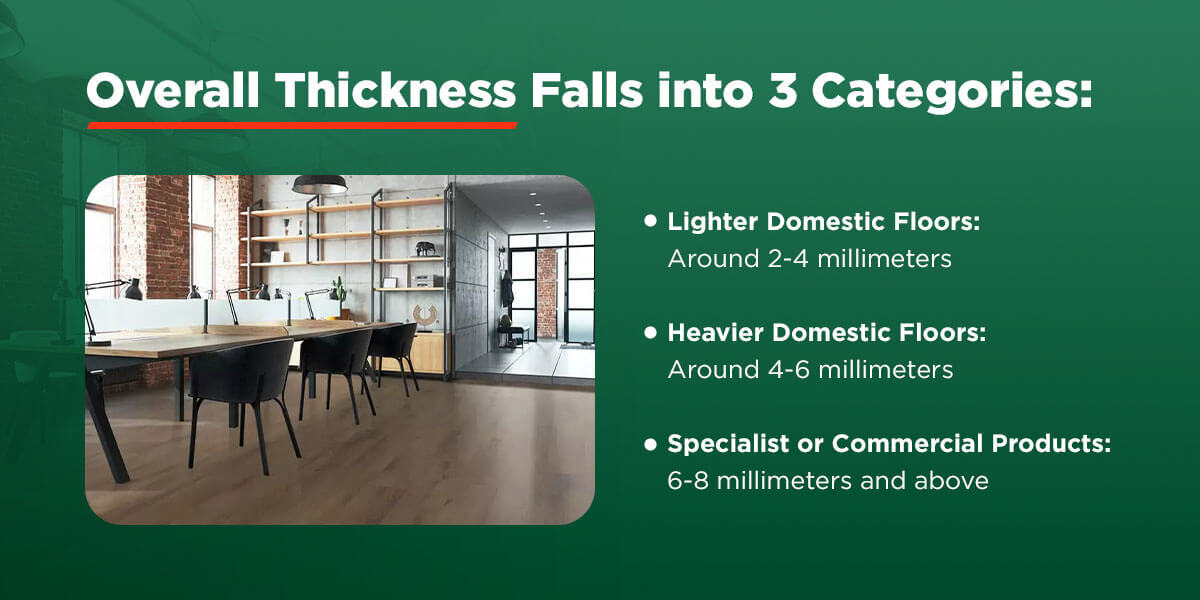
First is the overall thickness, which is simply the distance from the backing to the clear protective coating on the top. This tends to fall into three rough categories:
- Lighter domestic floors: Around 2-4 millimeters
- Heavier domestic floors: Around 4-6 millimeters
- Specialist or commercial products: 6-8 millimeters and above
Second is the wear layer, which is the transparent upper layer that lies on top of the printed design. This is also the layer that absorbs most of the scuffs, chair scrapes and other fine scratches. The wear layer is typically measured in thousands of an inch, or mils. For standard residential use, wear layers of 12-20 mils are usually sufficient, while higher-traffic or light commercial areas often require 20+ mils.
The two work hand in hand. The overall thickness affects how “solid” your floor feels and how well it can handle small imperfections in the subfloor. The wear layer determines how well the floor will look in five or 10 years' time.
Many people make the mistake of focusing only on the total thickness of the product and ignoring the wear layer. Often, a thinner vinyl with an excellent wear layer will perform better in a high-traffic area than a thicker vinyl with a poor-quality, thin wear layer.
How to Choose the Right Thickness
The easiest way to choose the correct thickness is to work backward from your home, not from the label. To do this, think about the room itself and how the space works on an average day, before you start comparing products.
A spare bedroom will not see as much foot traffic as a hallway. Your living room may have children playing on the floor, the dog running around or furniture being moved every time you vacuum. Although these rooms are all in the same house, they have different needs and won't require the same thickness of flooring.
The second part of the equation is the subfloor. For example, a smooth, solid and flat concrete subfloor is very forgiving as far as damage goes. On the other hand, an older tile floor with large gaps between the tiles will create different stress points on the vinyl flooring. This is where thickness and quality become important factors. Once you have a better idea of what a typical day in the room looks like, the thickness guidelines will start to feel much clearer.
Matching Vinyl Flooring Thickness to Different Rooms
Low-traffic areas like bedrooms, guest bedrooms or home offices don't put much pressure on the flooring. For these spaces, a vinyl thickness of around 2-4 millimeters with a decent wear layer is likely sufficient. Vinyl flooring products with a thickness of 6-8 millimeters are typically used in commercial spaces such as shops, offices and other public buildings. You could use these at home, but it's not really necessary, unless that particular room is extremely busy.
Here's a quick vinyl flooring thickness guide for different areas of your home:
Kitchens and Entryways
These are busy, messy areas. A sensible target here is:
- Total thickness: 5-7 millimeters
- Wear layer: 12-20 mils (20 mils if your kitchen is the main hub of the home)
That combination gives you a solid feel under heavy appliances and enough surface protection for everyday knocks and scrapes.
Living Rooms and Hallways
These spaces can look quite different from home to home. As a rough guide:
- Total thickness: 5-7 millimeters
- Wear layer: At least 12 mils (20 mils if you have children or pets)
Bedrooms and Home Offices
These rooms usually see less impact and fewer spills. Our recommendation is:
- Total thickness: 4.5-5 millimeters
- Wear layer: 12 mils
Basements and Lower Levels
Here, the type of core — for example, SPC rigid core — matters as much as the numbers. These products are made to cope with changing temperature and a bit more moisture.
If you are finishing a basement, focus on a rigid, waterproof LVT designed for below-grade, with a strong wear layer. A good baseline is:
- Total thickness: 5-6 millimeters
- Wear layer: 20 mils
Installation Methods and Vinyl Floor Thickness
Most vinyl flooring fitted in houses is either glued down to the subfloor or installed as a floating floor, using click-together planks.
In glue-down vinyl installations, the vinyl is adhered directly to your subfloor. This means that the stability comes primarily from that subfloor and the adhesive used. As long as your subfloor is relatively smooth, level and solid, a thinner or midrange vinyl can still feel sturdy underfoot.
Click-lock systems are installed differently. Each plank locks into another and sits upon the subfloor, with an additional layer of underlay. Here, a slightly thicker board usually performs better as it feels more stable and handles imperfections in the subfloor better. It's important to keep this in mind before deciding on the best option.
See Vinyl Flooring Options at Carpet & Tile Mart
Thickness is one of those details that make more sense when you can see the board rather than just reading the label. At Carpet & Tile Mart, we have stores in Delaware, Pennsylvania and South Jersey, with a large range of vinyl flooring on display, so you can clearly see the difference and the options available.
Our staff are happy to talk through the options, understand how you use the space, and help you narrow the choice to a thickness and wear layer that is suitable for your home. You can use our store locator tool to find a location near you.